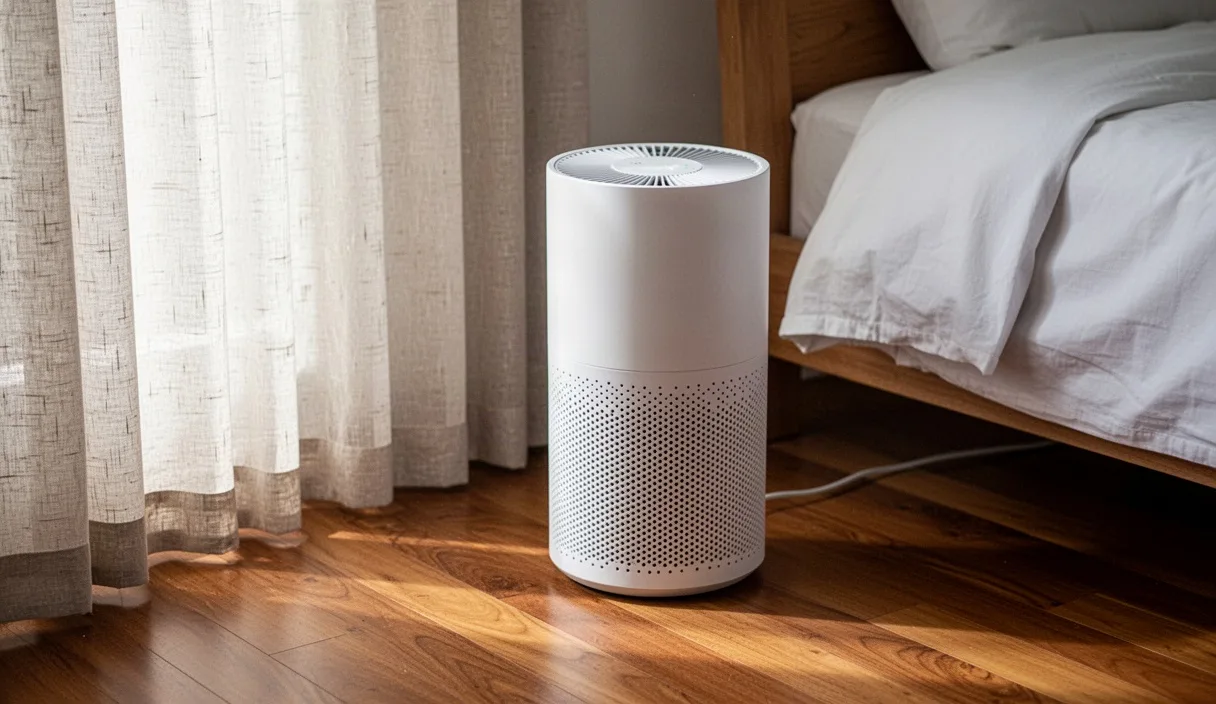
Bedrooms collect an exceptional concentration of settled and airborne dust. Textile friction from sheets and blankets, shedding skin cells, pet dander, and microscopic fibers from clothing create a continuous reservoir of debris in a space where people spend seven to nine continuous hours each night. When air currents disturb these fabrics, fine particles lift back into the breathing zone. Choosing an effective air cleaning system requires balancing particulate removal efficiency against sound levels, electrical draw, and secondary indoor emissions.
Two primary technologies dominate the residential market for clearing dust: mechanical filtration using High-Efficiency Particulate Air (HEPA) media, and electronic air cleaning using ionizers or electrostatic precipitators. While both technologies claim to remove floating debris, their operational principles differ fundamentally. A mechanical filter relies on dense fibers and physical entrapment through forced air, whereas an ionizer alters the electrical charge of surrounding particles so they attach to room surfaces or charged collection plates. Understanding how each process behaves in an enclosed sleeping environment helps determine which unit suits your space.
How Mechanical HEPA Media Traps Fine Particulates
Mechanical HEPA filters use a thick mat of randomly arranged borosilicate glass or synthetic polymer fibers. Unlike a simple kitchen sieve, which only blocks objects larger than its openings, HEPA media uses four distinct aerodynamic mechanisms to capture particles of varying masses and velocities. A motorized fan pulls bedroom air through the pleated matrix, forcing particles into contact with the fibers where intermolecular van der Waals forces hold them permanently.
The four capture mechanisms operate across distinct size ranges:
- Straining or Sieving: Occurs when large dust fibers, hair, and lint cannot fit through the physical spaces between adjacent glass fibers and lodge across the surface.
- Inertial Impaction: Heavier dust particles, generally those larger than one micrometer, possess too much momentum to follow the air streamlines as the air curves around a fiber. They break out of the airflow path and collide head-on with the fiber surface.
- Interception: Mid-sized particles follow the moving air path closely. When a particle travels within one particle-radius of a fiber, its edge touches the fiber and becomes trapped.
- Diffusion: The smallest particles, typically below 0.2 micrometers, bounce erratically against gas molecules in a phenomenon known as Brownian motion. This zigzag path increases the transit time through the filter depth and brings ultra-fine soot, smoke, and mineral dust into direct contact with the fibers.
Because of these overlapping physics, the most difficult particle size for a mechanical filter to trap sits around 0.3 micrometers. Air purifiers certified under the United States Department of Energy standard must trap particles at this Most Penetrating Particle Size (MPPS) without relying on chemical agents or electrical fields. In a bedroom, this mechanical action steadily depletes the floating dust load every time the room air cycles through the media, depositing the collected mass safely inside the disposable cartridge.
The Mechanism Behind Electrostatic Air Cleaners
Ionizers and electrostatic air cleaners take an active approach to dust rather than relying solely on high-resistance physical barriers. An ionizer uses high-voltage needlepoints or corona discharge wires, often operating between 4,000 and 12,000 volts of direct current, to shed electrons into the surrounding air. These free electrons collide with ambient gas molecules, creating negative ions (and in some dual-polarity units, positive ions).
Once charged ions disperse into the bedroom, they attach to floating dust particles, pet allergens, and pollen through field charging or diffusion charging. This process increases the net electrical charge of the debris. From here, the cleaner handles the charged dust in one of two configurations:
- Pin-point needle ionizers (plateless): These units release ions directly into the room without an internal collection mechanism. The charged dust particles become attracted to grounded surfaces nearby, such as painted drywall, window curtains, bedding, and carpet. The particles drop out of the air and adhere firmly to room fixtures.
- Two-stage electrostatic precipitators: These devices pull air through an ionizing zone that charges the particles, followed by an internal collector cell containing closely spaced alternating grounded and high-voltage plates. The charged dust is driven by electrical attraction directly onto the metal plates, which capture the debris for later manual washing.
The table below summarizes the core differences between mechanical filtration and electrostatic mechanisms across common performance metrics:
| Operational Factor | True HEPA Filtration | Electrostatic Ionization |
|---|---|---|
| Primary Capture Method | Dense borosilicate fiber matrix | Corona discharge charging particles |
| Dust Deposition Site | Inside disposable filter core | Internal metal plates or bedroom walls |
| Airflow Resistance | Moderate to high, requires robust fan | Very low, operates with quiet or weak fan |
| Secondary Emissions | None (inert mechanical process) | Potential ozone and nitrogen oxide output |
| Maintenance Demands | Cartridge swaps every 6 to 12 months | Frequent manual washing of metal pins or plates |
Evaluating Secondary Byproducts and Ozone Output
The primary concern when placing an electronic cleaner in a bedroom is the generation of ground-level ozone (O3) and related reactive oxygen species. Ozone forms when high-voltage electrical fields split diatomic oxygen (O2) molecules into individual oxygen atoms, which then bind with standard oxygen pairs. In an unventilated bedroom where doors and windows remain shut for eight hours, ozone concentrations can accumulate to levels that irritate mucosal tissues.
Ozone is a potent lung irritant. Clinical research demonstrates that exposure to elevated ozone can trigger coughing, throat discomfort, shortness of breath, and bronchial inflammation, particularly in individuals with pre-existing asthma, chronic bronchitis, or seasonal allergies. While the United States Food and Drug Administration caps ozone output for medical devices at 0.05 parts per million (ppm), and California Air Resources Board (CARB) certification requires concentrations below 0.050 ppm for residential air cleaners, even permissible trace emissions can react with ambient household chemicals.
When ozone encounters terpenes found in scented laundry detergents, wood polishes, or essential oils often used in bedrooms, it triggers rapid secondary chemical reactions. These gas-phase reactions generate formaldehyde, acetaldehyde, and ultrafine organic aerosols directly in the breathing space. True HEPA filters produce zero ozone and generate no chemical byproducts because their operation is entirely inert. If you suspect chronic respiratory symptoms or have a family history of reactive airway disease, consult a pulmonologist or an indoor environmental consultant before introducing any corona discharge device into a sleeping area.
Room Volume Calculations and Clean Air Delivery Rates
Air cleaners cannot remove dust effectively unless they process sufficient air volume to outpace the room generation rate. The Association of Home Appliance Manufacturers (AHAM) uses the Clean Air Delivery Rate (CADR) to measure performance. CADR reflects both the airflow volume in cubic feet per minute (CFM) and the removal efficiency of specific contaminants: dust, tobacco smoke, and pollen.
To determine the CADR necessary for your bedroom, you must calculate total room volume and establish a target for Air Changes per Hour (ACH). For noticeable dust reduction and allergen management, aim for four to five air changes per hour.
Calculating Required Airflow
- Measure Room Dimensions: Measure the length, width, and ceiling height in feet. Multiply these values to find total cubic volume. For example, an average bedroom measuring 14 feet by 12 feet with an 8-foot ceiling contains 1,344 cubic feet.
- Establish Total Hourly Volume: Multiply the room volume by your target air changes per hour. For four air changes: 1,344 cubic feet multiplied by 4 equals 5,376 cubic feet per hour.
- Convert to Minutes: Divide the hourly requirement by 60 minutes to find the necessary CADR rating. 5,376 divided by 60 equals an 89.6 CFM dust CADR.
A simple rule of thumb for standard 8-foot ceilings is the two-thirds guideline: select an air purifier with a dust CADR rating equal to at least two-thirds of the room square footage. A 168-square-foot bedroom requires a minimum dust CADR of 112 CFM. Mechanical HEPA units routinely achieve dust CADR numbers between 150 and 320 CFM because their sealed blowers drive large air volumes through pleated frames. In contrast, many standalone bedroom ionizers rely on silent convection airflow or small computer-style fans, frequently delivering true CADR values under 40 CFM, which is inadequate for keeping dust from falling onto nightstands and bedding.
Filter Replacement Intervals and Yearly Upkeep
The total cost and maintenance schedule of an air cleaner determine whether it remains effective over several years of use. Neglected equipment experiences dramatic drops in dust collection efficiency and can strain electrical motors.
Mechanical HEPA systems require routine upkeep divided across two distinct filtration layers:
- Pre-filter care: The external foam or mesh screen catches heavy pet hair, lint, and large dust clusters. Vacuum or wash this screen every two to four weeks. Keeping the pre-filter clear prevents airflow bottlenecks and protects the fragile HEPA folds beneath it.
- Main HEPA cartridge swap: As microscopic dust lodges within the fibers, the spaces between them gradually fill. Air resistance increases, slightly lowering CFM while maintaining high particulate retention. Most residential HEPA barrels or flat panels require complete replacement every 6 to 12 months, depending on pet occupancy and outdoor air quality. Replacement filters cost between $35 and $95 per cycle.
Electrostatic precipitators and ionizers avoid recurring filter purchases, but they demand rigorous manual labor. The ionizing wires and collector plates collect an oily layer of charred dust that reduces their electrical potential. If the collection plates become caked with debris, their efficiency drops sharply, and the unit may produce audible snapping sounds or increased ozone. Users must soak and scrub metal collector cells in warm soapy water every two to three weeks, ensuring the metal dries completely before reinserting it into the high-voltage chassis. Plateless needlepoint ionizers also require frequent dry-swabbing of the emitting pins to remove accumulated dust whiskers that inhibit electron discharge.
Common Mistakes
Homeowners often undermine air purifier performance through small installation and operational oversights. Addressing these common habits ensures steady dust removal:
- Tucking the unit into a corner: Shoving a HEPA purifier tight against a baseboard or between a nightstand and a wall restricts intake grilles. Maintain at least 18 inches of clear space on all sides to allow circular airflow patterns to establish across the room.
- Running the unit on the lowest setting continuously: The CADR ratings printed on unit boxes reflect maximum fan speed. Running a unit on whisper-quiet mode may deliver only 20 to 30 percent of its rated capacity, failing to clear dust raised during bed-making. Run the fan on high during the day or for an hour before bed, then switch to a medium setting for sleep.
- Washing a non-washable HEPA filter: Rinsing a standard borosilicate HEPA core with tap water breaks down the delicate fiber matrix and collapses the pleats, destroying its fine-particle trapping geometry even if the paper appears undamaged once dry. Only clean filters explicitly stamped as washable by the original manufacturer.
- Relying on an ionizer to replace surface cleaning: Plateless ionizers force dust onto walls, baseboards, and floors, creating a ring of dark grime around the unit often called the black wall effect. Without regular damp wiping and HEPA vacuuming of floors, walking through the room simply kicks these charged dust clumps back into the air.
- Leaving bedroom doors and windows wide open: Purifying indoor air requires a managed envelope. Leaving large openings allows outdoor dust, vehicle emissions, and pollen to infiltrate faster than a standalone unit can capture them. Keep doors cracked slightly for fresh air balance or run dedicated mechanical ventilation.
Practical Next Steps for Bedroom Air Quality
To reduce overnight dust buildup systematically, begin by evaluating your room dimensions and current dust sources. Calculate your bedroom square footage and identify whether your primary goal is collecting floating dust fibers or addressing chemical odors. For almost all residential bedrooms, a mechanical True HEPA unit equipped with an activated carbon stage and a CADR rating matched to your room volume provides the most reliable dust reduction without introducing respiratory irritants.
Inspect existing purifiers to ensure their filters remain unclogged, and check manufacturer data sheets for genuine mechanical ratings rather than ambiguous marketing terms like "HEPA-type." If you currently use an electrostatic device, verify that it holds a valid zero-ozone or CARB-compliant certification, and establish a bi-weekly schedule to scrub the collector plates. If you wake persistently with sinus congestion, unexplained coughing, or irritation despite maintaining clean filters, arrange an evaluation with a certified HVAC technician to check whole-home ductwork, or speak with an allergist to pinpoint specific environmental triggers.